Cosmos

Cosmos is a dataset created in collaboration with a community of health systems using Epic and is designed to improve patient care. By combining their data, participating organizations and Epic can make new discoveries and advance medicine. Cosmos also powers tools at the point of care, providing insights to clinicians that are tailored to the patient in front of them.
More about Cosmos →

Cosmos Community

1,949
Hospitals
300 Million
Patients
43.2K
Clinics
Meet a few of our Cosmos community members:
Southeast Health
Hoag
Children's Hospital Colorado
Yale New Haven Health System and Yale University
Piedmont Healthcare
NCH Healthcare System
Orlando Health
Stanford Children's Health
Learn more about the Cosmos community →

Cosmos in Action

Cosmos at the Point of Care

The vision for Cosmos has always included empowering providers with data to improve care for their patients. With our recently released and ongoing development of Cosmos-enabled features, providers can use attributes from the patient in front of them to review personalized insights they can use alongside their own expertise and experience to partner with their patient on shared decision-making. Some examples include:

Best Care Choices

To further evidence-based care, Best Care Choices for My Patient shows providers insights into how similar patients responded to the treatments they are considering, right at the point of care. Physicians will be able to explore the collective knowledge from millions of clinical decisions to see treatments and resulting outcomes for patients like the one in front of them.

Look-Alikes

Very rare conditions and medical mysteries often result in limited evidence for a physician to draw from when determining a course of action or treatment for their patient. Look-Alikes enables providers to connect with other providers across the Cosmos community who might have experience with patients with a similar constellation of symptoms or condition so they can collaborate on care.

Condition-Specific Growth Charts

Standard growth charts often don't account for disease-specific nuances that can influence a child's development. When a chronic condition affects a child’s growth, Cosmos enables growth charts that show clinicians and family members how the child is progressing relative to others with the same disease.

Epic Research

While traditional research continues to serve as a primary source of information to inform clinical practice, we identified a need for a new kind of analysis focused on getting good data out quickly to clinicians and decision-makers where it can make a difference. To address this need, we launched Epic Research. Using our dual-team process, Epic Research teams evaluate timely, topical, and relevant questions and make findings available to the public at no-cost at EpicResearch.org.
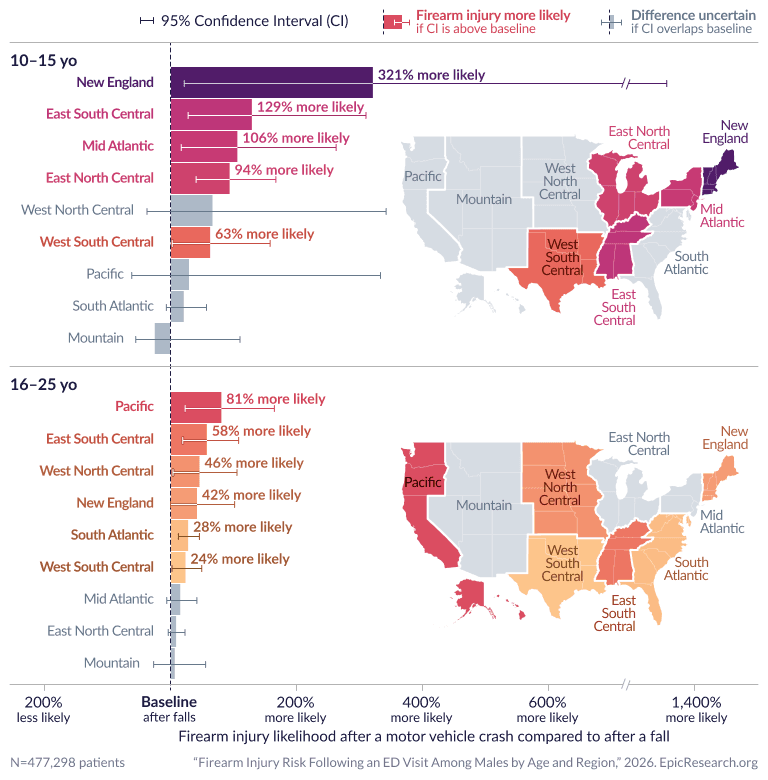
Firearm Injury Risk Following an ED Visit Among Males by Age and Region

ED Visits for Motor Vehicle Crashes Associated with Elevated Risk of Subsequent Firearm Injury for Young Male Patients

Male patients aged 10 to 15 who had an ED visit for a motor vehicle crash (MVC) were as much as four times as likely to experience a subsequent firearm injury compared with those whose ED visit was for a fall, in some parts of the United States.

Read the full brief on Epic Research →
MI Risk by Average Systolic BP and Sex

Cardiovascular Event Risk Increases More Sharply for Men Than Women at Very Low Average Blood Pressure

The risks of myocardial infarction (MI), ischemic stroke, and hemorrhagic stroke are increased for patients with high or low average systolic blood pressure (BP). The risks are greater at very low systolic BP than at very high systolic BP.

Read the full brief on Epic Research →
Proportion of Patients by Weight Change After Stopping Semaglutide

Two Years After Stopping GLP-1s, Most Patients Sustain at Least Some Weight Loss

At 24 months post-cessation, 56% of semaglutide, 52% of liraglutide, and 55% of tirzepatide patients kept the weight off or lost additional weight.
Read the full brief on Epic Research →
12-Month Rolling Rate of Overdose Emergency Department Visits Over Time

Fentanyl Testing Associated with Short-Term Survival Benefits; Increased Long-Term Mortality Risk Among Overdose Patients

The 12-month average rate of emergency department (ED) visits for overdoses of all types declined from a peak of 946 per 100,000 ED visits in March 2021 to 634 per 100,000 ED visits in November 2025, falling below pre-COVID-19 pandemic levels. Testing for fentanyl in these encounters more than quadrupled over this period, from 5% of encounters to 28% of encounters.

Read the full brief on Epic Research →
Explore more studies and data insights from Cosmos
on Epic Research →
This page is not viewable using Internet Explorer. Please try accessing it with an alternate browser.